AROS
An AI-native VR experience that turns a futures-research concept for a partially autonomous underwater habitat into a world you can enter — and uses that world to test where generative AI helps, breaks, and still needs design judgment.
Three-person research and prototype team · Futures research, scenario design, in-world prototyping, AI art direction, Unity assembly, spatial audio, and validation on Meta Quest 3 and 3S.
30-SECOND PROJECT READ
The project at a glance.
- Challenge
- Make a speculative underwater-habitat system concrete enough to experience, question and validate in VR.
- My role
- Futures research, scenario design, AI art direction, diegetic interface design, Unity assembly and validation.
- Team
- Three-person research and prototype team.
- Timeline
- VR research prototype · 2025
- What shipped
- A complete Meta Quest experience with an explorable habitat, spatial audio and integrated generated assets.
- Outcome
- The prototype was validated on Quest 3 and 3S and documents exactly where AI accelerated production—and where design judgment remained essential.
Make a distant future concrete enough to challenge
The starting question was deliberately systemic: could modular, partially autonomous underwater habitats contribute to future housing — and which architectural, technological, ecological, economic, and political conditions would make a near-term pilot plausible? The aim was not to sell an underwater city. It was to build a research concept detailed enough that its tensions could be experienced and criticized.
“A believable future needs barriers, maintenance, and politics — not only a beautiful render.”
Research principle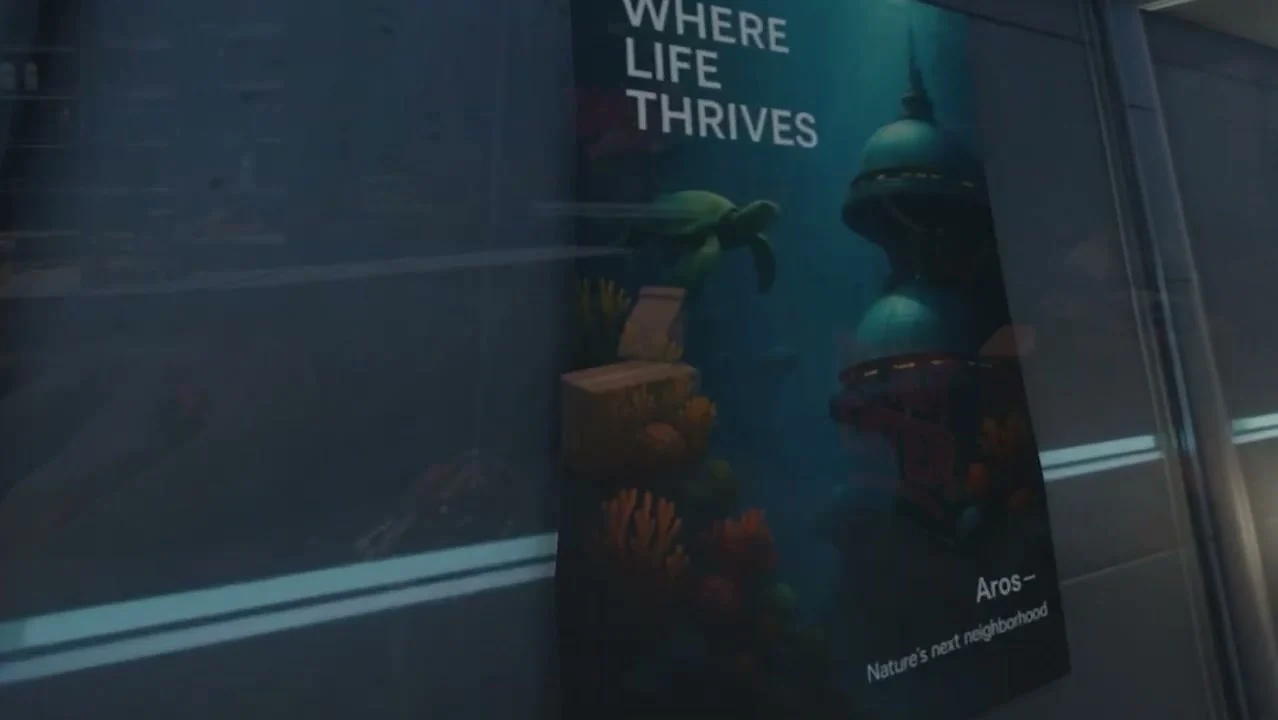
The habitat is a service system, not a shell
A STEEP analysis — checking the idea against social, technological, economic, environmental, and political factors — turned the broad vision into design constraints. Existing technologies such as desalination, aquaponics, tidal power, solar energy, and air processing are promising in isolation; the hard problem is combining them into a safe, maintainable whole. Social acceptance, psychological wellbeing, cost, regulation, and ecological impact are equally load-bearing.
Autonomy is a spectrum
A partially autonomous pilot with a surface connection was more credible than a sealed, self-sufficient city. Redundancy and emergency access became part of the concept.
Isolation changes the product
Light, space, mental wellbeing, trust, and everyday rituals matter as much as pressure-resistant architecture when the environment cannot be left casually.
The ocean is not empty land
Noise, light, sediment, construction, and continuous monitoring create ecological costs. A habitat must be designed with marine systems, not simply placed inside them.
Separate the forces pushing, pulling, and resisting change
The Future Triangle exposed three competing forces: climate pressure, urbanization, and advances in closed-loop systems push experimentation forward; visions of resilient, regenerative micro-societies pull it toward an attractive future; high cost, failed prestige projects, cultural unease, and unclear governance weigh it down. A follow-up method, Causal Layered Analysis, then dug past those forces into the stories underneath — Atlantis, Noah’s Ark, the underwater space station — and the exclusion those myths can hide.
“Without pilot projects and clear governance, the habitat remains a speculative future no matter how convincing the image looks.”
Future Triangle synthesis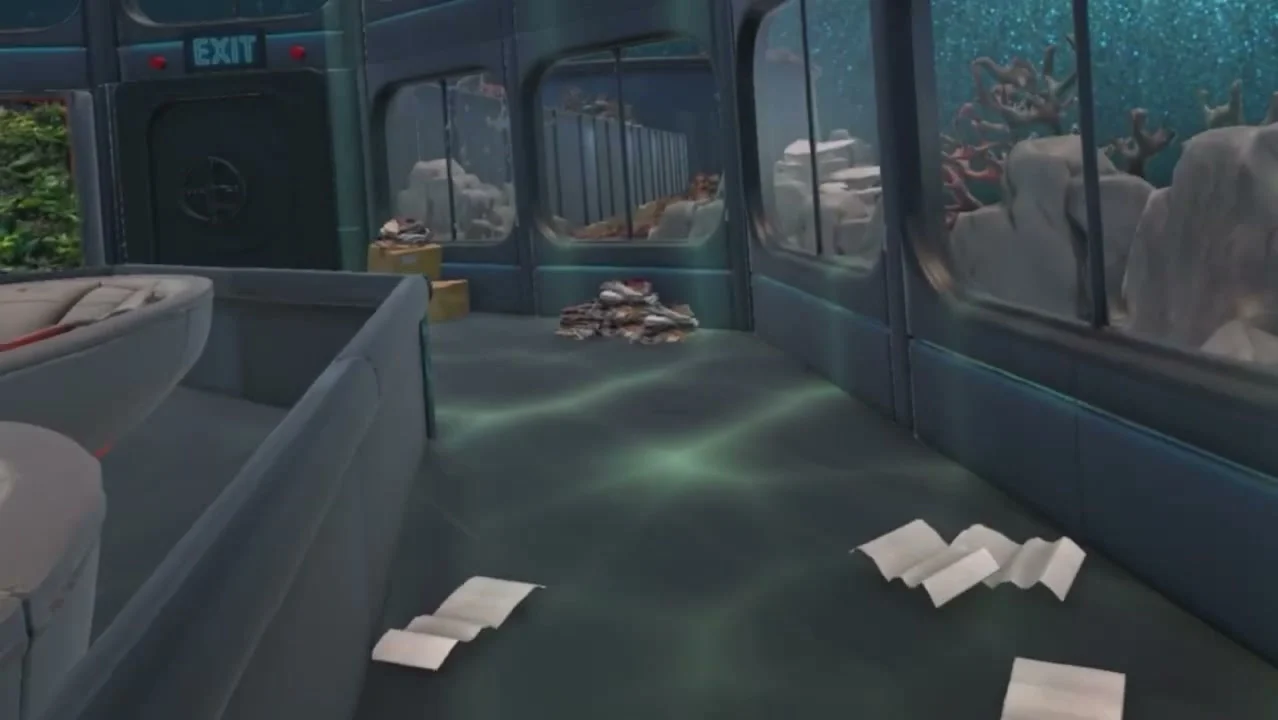
Choose a useful tension, not a perfect future
A 2×2 matrix crossed technological maturity with political and social support. AROS was shaped around the most productive tension: a supported pilot where the technology is still imperfect. That made repair culture, shared responsibility, open knowledge, and visible system limits more useful than luxury or automation that hides its own limits.
Aquatic realism
NGOs, research groups, and citizen-science programs operate test stations while the technology remains incomplete and publicly discussable.
Blue renaissance
International consortia and startups move into standardized pilots — an attractive scenario, but one that can conceal access, ownership, and ecological questions.
Lost depth
Technical progress continues behind weak governance, producing private parallel worlds rather than shared infrastructure.
Turn systems research into environmental clues
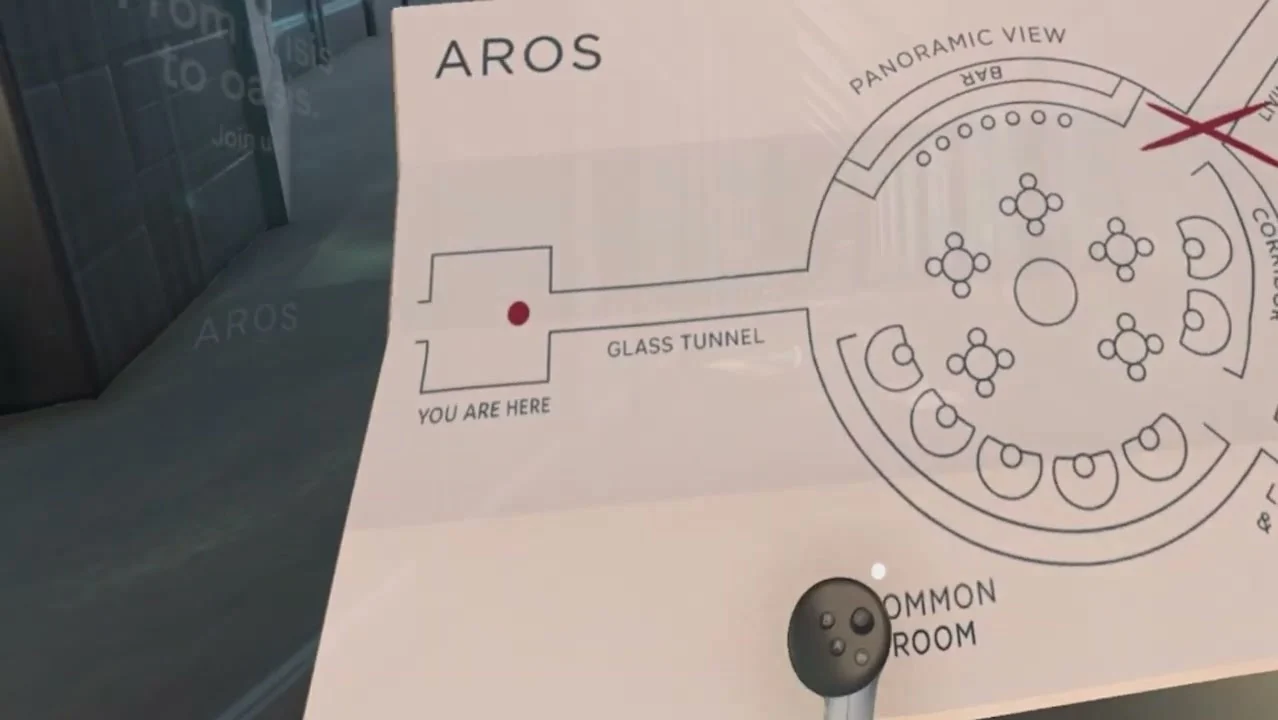
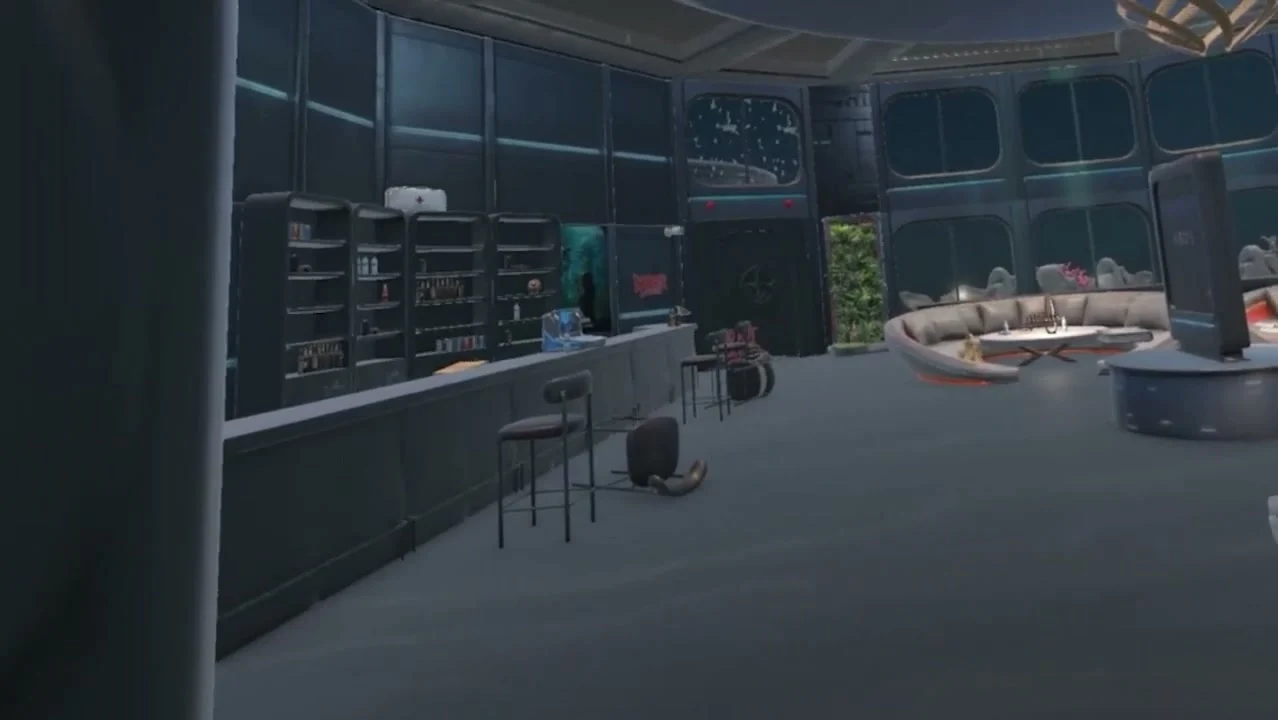
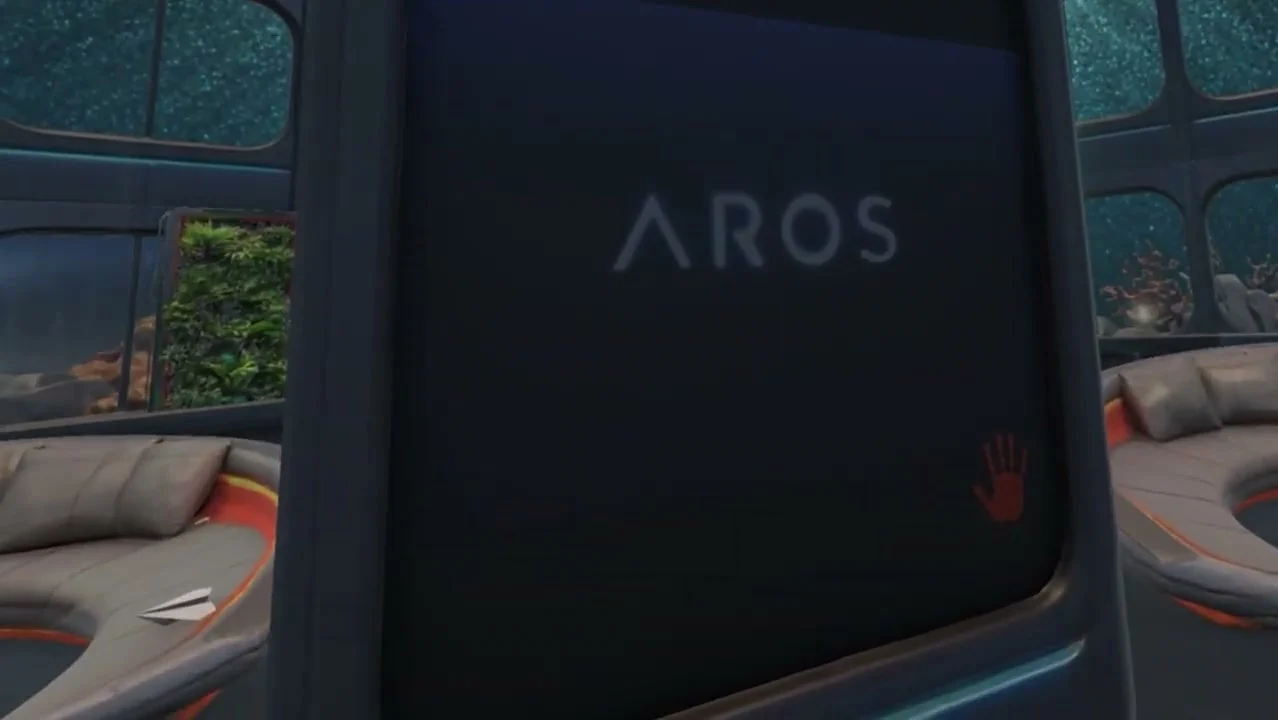
The VR experience avoids a floating presentation deck. A physical map, hand-scale interaction, labeled rooms, exit markers, discarded notes, repair traces, supplies, plants, and an unsettled common room let visitors read the habitat through their own movement. The space communicates both the promise of collective life and the friction of keeping it running.
Put navigation in the world
A handheld “you are here” map gives the visitor a stable reference without filling the view with a permanent HUD.
Let the room show the pressure
Scattered objects, closed doors, warning graphics, and visible supplies turn maintenance and uncertainty into environmental storytelling.
Design at human scale
Controller and hand affordances make the concept something to inspect from inside, not another distant architectural visualization.
Use AI across the pipeline — keep authorship in the decisions
AROS was a deliberate limit test: the visible and audible content was generated with AI, while the team shaped the concept, prompts, selection, cleanup, spatial composition, interaction, and final experience in Unity. The source repository makes the boundary clear. AI supplied raw ingredients; the real-time product still needed a designed system.
One generated world asset
The repository contains the generated habitat mesh and a 2048px texture. Turning that output into a traversable space still required materials, layout, collision, scale, and performance judgment.
43 generated sound files
Music, underwater ambience, doors, airlocks, warnings, tools, diary material, and ElevenLabs voices were organized into a spatial soundscape rather than played as a flat soundtrack.
Unity remained the product layer
Unity 6, Meta XR SDK 77, OpenXR, URP, the Input System, spatial audio, and grab interaction handled the experience. No live generative model is required at runtime.
What “AI-based” actually meant
“Generation covered the content pipeline. Unity, XR interaction, spatial composition, and device validation turned that material into a product.”
VRXAI repository and trailer evidenceThese are repository and build facts, not player-outcome metrics. They describe the production footprint and runtime boundary of the prototype.
Build the interface into the world, keep the exit obvious
VR added a practical design constraint to the speculative one: visitors need orientation, readable affordances, and a reliable way out before the story can work. The map sits inside the world, the controller is visible at the point of action, rooms are named, and exit signage is treated as part of the environment. That keeps attention on the habitat while preserving control.
“In immersive products, orientation is not onboarding copy. It is an interaction that must remain available in the world.”
VR interface principleFrom concept render to a working Quest build
The world was assembled in Unity 6000.1.9f1 and validated on Meta Quest 3 and 3S. Repository history records Link compatibility, asset integration, and spatial-sound testing as explicit milestones. That target-device loop matters: scale, legibility, audio position, controller behavior, and performance only become product questions once the concept is running inside the headset.
“The headset was the point where a generated asset pipeline had to become an experience.”
Prototype milestoneAI accelerated production — design held the system together
Research before prompting
The STEEP analysis, futures methods, and scenario matrix created the constraints that made generated output part of one world instead of a collection of attractive fragments.
Generation is not integration
Meshes and sounds arrived quickly; coherence, navigation, spatial composition, XR setup, and target-device behavior still depended on human decisions and Unity work.
Show the limits in the concept
Repair, imperfection, shared maintenance, and uncertainty became themes inside AROS — a more honest fit for the AI pipeline than pretending every output was flawless.
AROS is a futures concept and an AI-production limit test. It does not prove that underwater housing is viable, that the generated assets are production-ready at scale, or that the experience has a validated player outcome. The available sources contain no formal usability metrics.
Test comfort, wayfinding, legibility, and narrative comprehension with participants; profile the world on-device; audit asset provenance and licensing; then compare AI-assisted and conventional production against the same quality bar.